

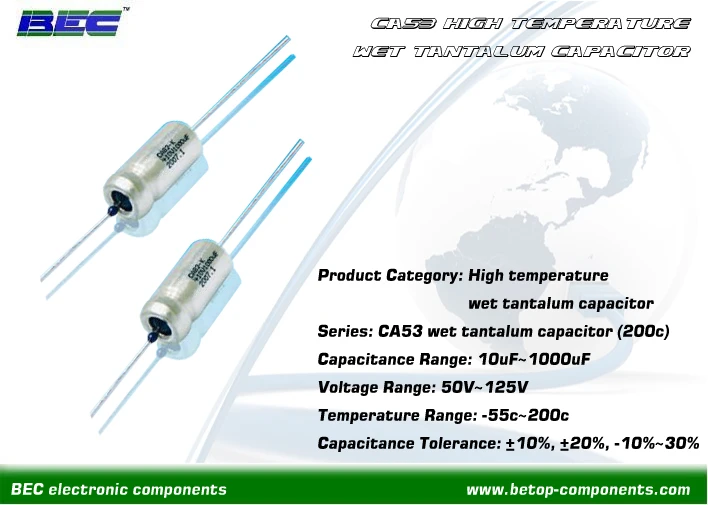
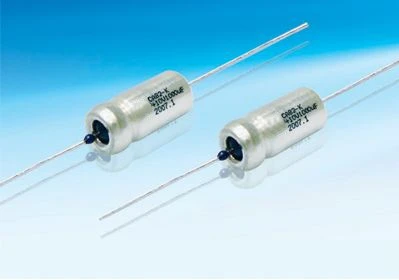
A CA53 axial wet tantalum capacitor produced by BEC is hermetically-sealed axial wet tantalum electrolytic capacitor compliant with QJ/PWV307-2009 national standard. It's engineered from -55°C to 200°C continuous ultra-high-temperature operation. It features a glass-to-tantalum hermetic seal and silver-coated metal case, delivering extreme thermal stability, ultra-low leakage, and robust mechanical performance-ideal for high-reliability non-corrosive and mild-corrosive harsh environments where half-sealed variants are insufficient. Its core strength lies in the fully hermetic design and 200°C rating, balancing reliability and cost for 200°C high-reliability applications. They are widely used in the industry of aerospace, military, oil drilling and mining.
Basic Parameters
|
Product Category |
CA53 axial wet tantalum capacitor in 180℃ |
|
Capacitance Range |
10UF~1000UF |
|
Voltage Range |
50V~125V |
|
Working Temperature |
-55℃~200℃ |
|
Tolerance |
±10%, ±20%, -10%~+30% |
|
Certificate |
RoHS, REACH |
|
Applications |
Aerospace, military and avionics, oil and gas Exploration, mining industry |
Characteristics
Glass-to-Tantalum Fully Hermetic Seal: Cylindrical silver-coated metal case with a molecularly tight glass-to-tantalum hermetic seal (the CA53's signature design feature) – far superior to half-sealed silver coatings (CA501/502/503) and standard metal hermetic seals. This seal eliminates electrolyte evaporation and blocks ingress of moisture, non-corrosive gases, and mild corrosive gases/fluids (e.g., low-concentration H₂S/CO₂), while withstanding thermal expansion/contraction at 200°C without micro-cracking (a common flaw in metal seals at extreme temperatures).
Ultra-Low Temperature-Dependent Leakage Current: Defined as the greater value of the two criteria (CR = rated capacitance (μF), UR = rated voltage (V)), the CA53 has significantly lower leakage than half-sealed 200°C CA503, critical for low-power 200°C circuits:
25°C (room temp): I0≤0.001CRUR (μA) or 1 μA
85°C (mid-range): I0≤0.01CRUR (μA) or 10 μA
200°C (max temp): I0≤0.04CRUR (μA) or 40 μA
Extreme Vibration & Shock Resistance: Compliant with aerospace/oilfield mechanical standards – withstands 10~2000Hz vibration (20g rms) and 500g peak shock with no lead fracture or seal micro-damage. The reinforced lead-to-seal weld and rigid tantalum-alloy leads prevent mechanical failure in high-stress environments (e.g., downhole drilling, missile launch, industrial furnace vibration).
Production Process


Parts of Our Production Facilities


FAQ
Q1: What are the storage requirements for a new CA53 capacitor?
A1: The CA53 has exceptional storage stability thanks to its glass-to-tantalum hermetic seal. The storage requirements are required as below:
Environment: Dry, cool, well-ventilated – 0°C ~ 30°C, relative humidity ≤85% (no condensation).
Avoid exposure: Keep away from corrosive gases (H₂S, Cl₂), direct sunlight, mechanical impact, heavy pressure, and strong electromagnetic fields.
Packaging: Store in the original sealed anti-static packaging (unpack only at immediate use to prevent physical damage to the seal/case).
No pre-testing is required for short-term storage (<24 months). For long-term storage (>24 months), only a 25°C leakage current test is needed before use (capacitance and DF remain within spec).
Q2: What is the CA53 capacitors' operating temperature range, and why does derating start at 85°C?
A2: Continuous operation: -55°C to +200°C, the possible highest temperature rating for hermetically sealed axial wet tantalum capacitors.
Mandatory derating starts at 85°C: A proactive design choice. The CA53's 200°C-optimized dielectric/electrolyte experience minor ion mobility changes above 85°C; early derating prevents cumulative thermal stress and ensures long-term stability at 200°C-critical for avoiding premature failure in ultra-high-temperature use.
Q3: Is the CA53 capacitor polarized, and how to identify its polarity correctly?
A3: Yes, the CA53 is strictly polarized (reverse installation causes irreversible dielectric breakdown and failure). Polarity is marked with high-temperature laser-etched markings to QJ/PWV307-2009 standards.
The longer axial lead = positive (+) terminal; shorter lead = negative (-) terminal (universal axial tantalum standard).
A continuous colored stripe/"+" symbol on the 200°C-rated insulation sleeve aligns with the positive lead.
Hot Tags: ca53 axial tantalum capacitor in 200°c, China ca53 axial tantalum capacitor in 200°c manufacturers, suppliers, factory, Vishay s tantalum capacitor, wet tantalum capacitor, CA53 Axial Tantalum Capacitor in 200 c, cylinder tantalum capacitor, Vishay M39006, solid tantalum


